


We can't find the internet
Attempting to reconnect
Something went wrong!
Hang in there while we get back on track
EXHIBITION
Elisabeth von Samsonow
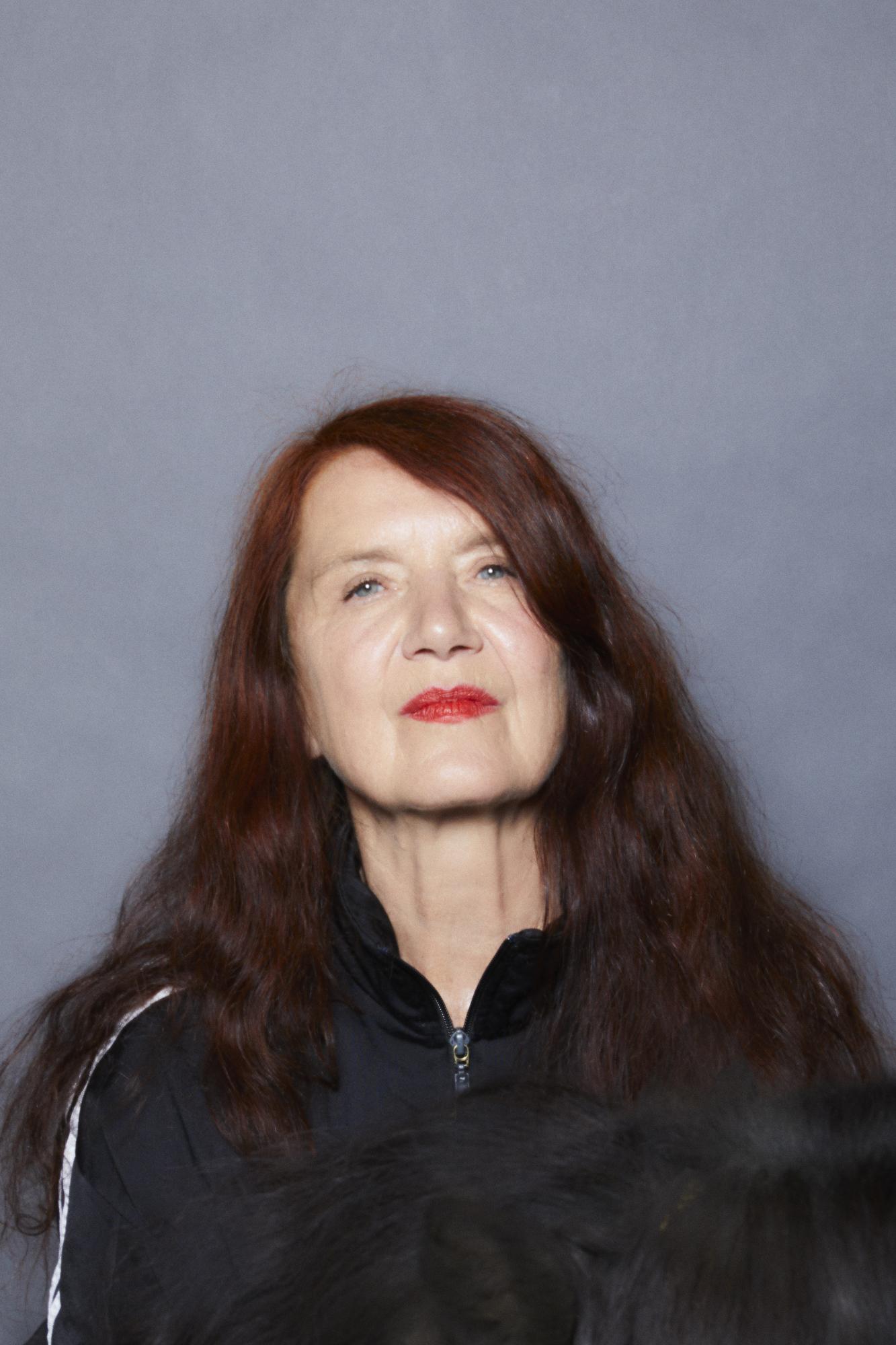
Elisabeth von Samsonow, Foto: Rafaela Pröll
As the first major exhibition under the new director, Verena Kaspar-Eisert, the Heidi Horten Collection is dedicating (*1956), presenting for the first time the full breadth and depth of her interdisciplinary body of work. Painting, sculpture, performance, photography, and drawing enter into a dialogue with her philosophical thought as well as her social and ecological commitment, offering the most comprehensive insight to date into Samsonow’s work.
At the heart of her artistic practice lies an exploration of the Earth as a living entity—as the bearer of history, energy, and collective memory. Drawing on ecofeminist thought, Samsonow develops alternative visions of coexistence and interconnectedness among humans, animals, plants, and the Earth.

19. September 2026 bis 28. Februar 2027
A central point of reference is the “Land of the Goddesses” in the Pulkautal valley in Lower Austria, where Samsonow combines artistic practice, ecological engagement, and community action. Ten works from the Heidi Horten Collection also enter into a deliberate dialogue with Samsonow’s works.
The exhibition is the first major retrospective in Director Verena Kaspar-Eisert’s program and is curated by Hana O. O. Haas and Rolf H. Johannsen. To mark the exhibition, the first comprehensive monograph on Elisabeth von Samsonow’s artistic oeuvre will be published.
An open studio underscores the exhibition’s participatory and dialogic nature, as well as the concept of an expanded artistic practice that is characteristic of Samsonow’s work. Visitors are invited to actively explore his interdisciplinary universe and reflect on an understanding of the world based on interdependence, connectedness, and responsibility.
Exhibition design: tne nextENTERprise architects

Download Presstext
Download Catalogue
Press images
Click on the images to download the respective image in 300 DPI.

Elisabeth von Samsonow
Photo: © Rafaela Pröll

Elisabeth von Samsonow
Photo: © Sophie THun

Elisabeth von Samsonow, Mirror Horses 1 and 2, 2023, Photo © Max Brucker
Elisabeth von Samsonow, Spiegelpferde 1 und 2, 2023 / Foto © Max Brucker

Elisabeth von Samsonow
Löss Untermarkersdorf, 2021, Photo: Maresa Jung

Elisabeth von Samsonow, Feathercoat, 1987, Photo Walter Bayer
Courtesy the artist
Elisabeth von Samsonow, Federmantel, 1987 / Foto © Walter Bayer

Elisabeth von Samsonow, Why Woman must Own the Territory 7/12, 2025

Elisabeth von Samsonow, When Disaster Strikes, the Centaurs Must Come to the Rescue, 2024, Egg tempera on jute, 200 × 150 cm, Courtesy the artist

Elisabeth von Samsonow, Geopsyche: Better Energy or the Return of the Swallows, 2022, Photo: Maresa Jung
Elisabeth von Samsonow, Geopsyche: Better Energy or the Return of the Swallows, 2022 / Foto © Maresa Jung

Elisabeth von Samsonow, from the series: Maps Land of the Goddesses, 2021, Photo © Maximilian Brucker
Elisabeth von Samsonow, from the series: Maps Land of the Goddesses, 2021 / Foto © Max Brucker

Elisabeth von Samsonow, Transplant B blau, 2014, Photo © Christoph Fuchs

Elisabeth von Samsonow, Ektoplasma - Yeah, 2012, Photo © Maximilian Brucker

Exhibition View Elisabeth von Samsonow, Heidi Horten Collection, Vienna, 2026, Photo © Simon Veres

Exhibition View Elisabeth von Samsonow, Heidi Horten Collection, Vienna, 2026, Photo © Simon Veres

Exhibition View Elisabeth von Samsonow, Heidi Horten Collection, Vienna, 2026, Photo © Simon Veres
EXHIBITION
Gottfried Bechtold. Betonporsche (Concrete Porsche)
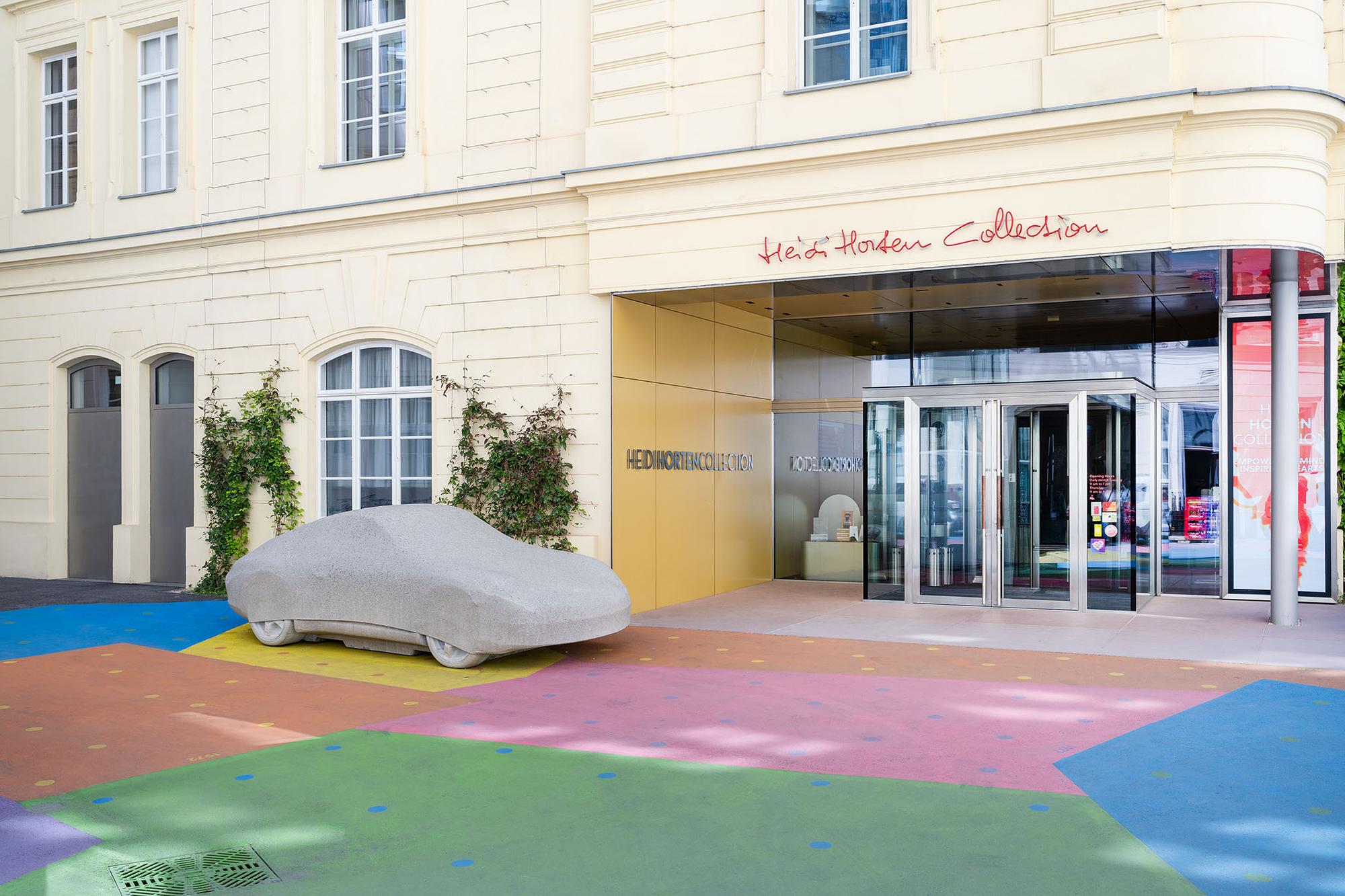
Gottfried Bechtold, Kiwanis Porsche
Gottfried Bechtold (*1947) is considered one of the defining figures of Austrian contemporary art. Since the late 1960s, he has developed a rigorously conceptual, cross-media practice encompassing sculpture, photography, drawing, text, and performative interventions in public space. His work is characterized by a precise analysis of social symbols and a sustained inquiry into perception, attribution of value, and the very conditions of artistic production.
Bechtold gained international recognition in particular for his engagement with the automobile as a cultural, economic, and ideological object. Since the 1970s, he has explored the car as a projection surface for beliefs in progress, promises of mobility, notions of status, and ideas of individual freedom.
The Concrete Porsche is among Bechtold’s most iconic works. The sculpture is an exact replica of a Porsche 911, cast in solid concrete. An object that normally stands for speed, elegance, and technical perfection is rendered literally heavy, immobile, and monumental. Concrete—symbolic of permanence, the construction industry, and urban infrastructure—stands in radical contrast to the very idea of a sports car. By stripping the object of its function, Bechtold transforms it into a sculpture that negates mobility while simultaneously exposing and questioning its cultural glorification.
29 April to 11 October 2026
At the end of April 2026, a Concrete Porschefrom the series Elf Elf (2006) will pull into the so-called “Director’s Parking Space” in the Hanuschhof courtyard. Weighing several tons, the sculpture subverts the promises of speed, freedom, and individual accessibility commonly associated with the automobile. Within the specific context of the courtyard, the work also unfolds a subtly ironic commentary on questions of ownership, privilege, and the hierarchical organization of space—particularly with regard to parking spaces as markers of power and status.
Bechtold’s interventions in public space are always defined by their precision of placement. At first glance, the Concrete Porsche appears familiar, yet its physical presence and materiality create a moment of dissonance. This very ambivalence—between recognizability and estrangement—is central to Bechtold’s artistic strategy. His works invite viewers to reread everyday symbols and to question their social meanings.
Complementing the installation, the auditorium will present photographs, films, and serial works that contextualize the Concrete Porsche and illuminate Bechtold’s long-standing engagement with the motif of the automobile, as well as with issues of reproduction, seriality, and documentation. These works make clear that the Concrete Porsche is not to be understood as a singular object, but as part of an artistic field of inquiry developed over decades.
Download Presstext
Download Catalogue
Press Photos
Click on the images to download the respective image in 300 DPI.

Gottfried Bechtold, Elf Elf, 2006
selbstverdichteter Beton, ca. 16,4 t
130 x 443 x 181 cm
Foto: © Simon Veres, Heidi Horten Collection

Gottfried Bechtold, Elf Elf, 2006
selbstverdichteter Beton, ca. 16,4 t
130 x 443 x 181 cm
Foto: © Simon Veres, Heidi Horten Collection

Gottfried Bechtold, Elf Elf, 2006
selbstverdichteter Beton, ca. 16,4 t
130 x 443 x 181 cm
Foto: © Simon Veres, Heidi Horten Collection

Gottfried Bechtold, Elf Elf, 2006
selbstverdichteter Beton, ca. 16,4 t
130 x 443 x 181 cm
Foto: © Simon Veres, Heidi Horten Collection

Gottfried Bechtold
Foto: © Miro Kuzmanović, Heidi Horten Collection

Ausstellungsansicht Gottfried Bechtold. Betonporsche
Foto: © Simon Veres, Heidi Horten Collection

Ausstellungsansicht Gottfried Bechtold. Betonporsche
Foto: © Simon Veres, Heidi Horten Collection

Ausstellungsansicht Gottfried Bechtold. Betonporsche
Foto: © Simon Veres, Heidi Horten Collection
Verena Kaspar-Eisert's Inaugural Press Conference
With Verena Kaspar-Eisert taking the helm, the Heidi Horten Collection is positioning itself as an open space for thought and experience, where the collection, exhibition program, and art education interact on an equal footing. The existing collection will be consistently reinterpreted from a contemporary perspective, strategically expanded—particularly to include female and contemporary artists—and placed in dialogue with current social issues.
The 2026 program spans a thematic arc from the major spring exhibition *ANIMALIA: Of Animals and Humans* to exciting artistic interventions in public space such as *Gottfried Bechtold. Betonporsche to a comprehensive solo exhibition on Elisabeth von Samsonow, as well as collection presentations centered on Andy Warhol’s early work. The exhibition program is accompanied by a wide range of educational offerings with a strong focus on inclusion, children, and young people.
You can find all details regarding the program, collection, educational programs, and institutional mission in the press release download.


Heidi Horten Collection, Foto: Ouriel Morgensztern


Heidi Horten Collection, KLIMT ⇄ WARHOL, Fotos: Ouriel Morgensztern


Verena Kaspar-Eisert, Direktorin, Foto: Klaus Pichler
CO2ntext
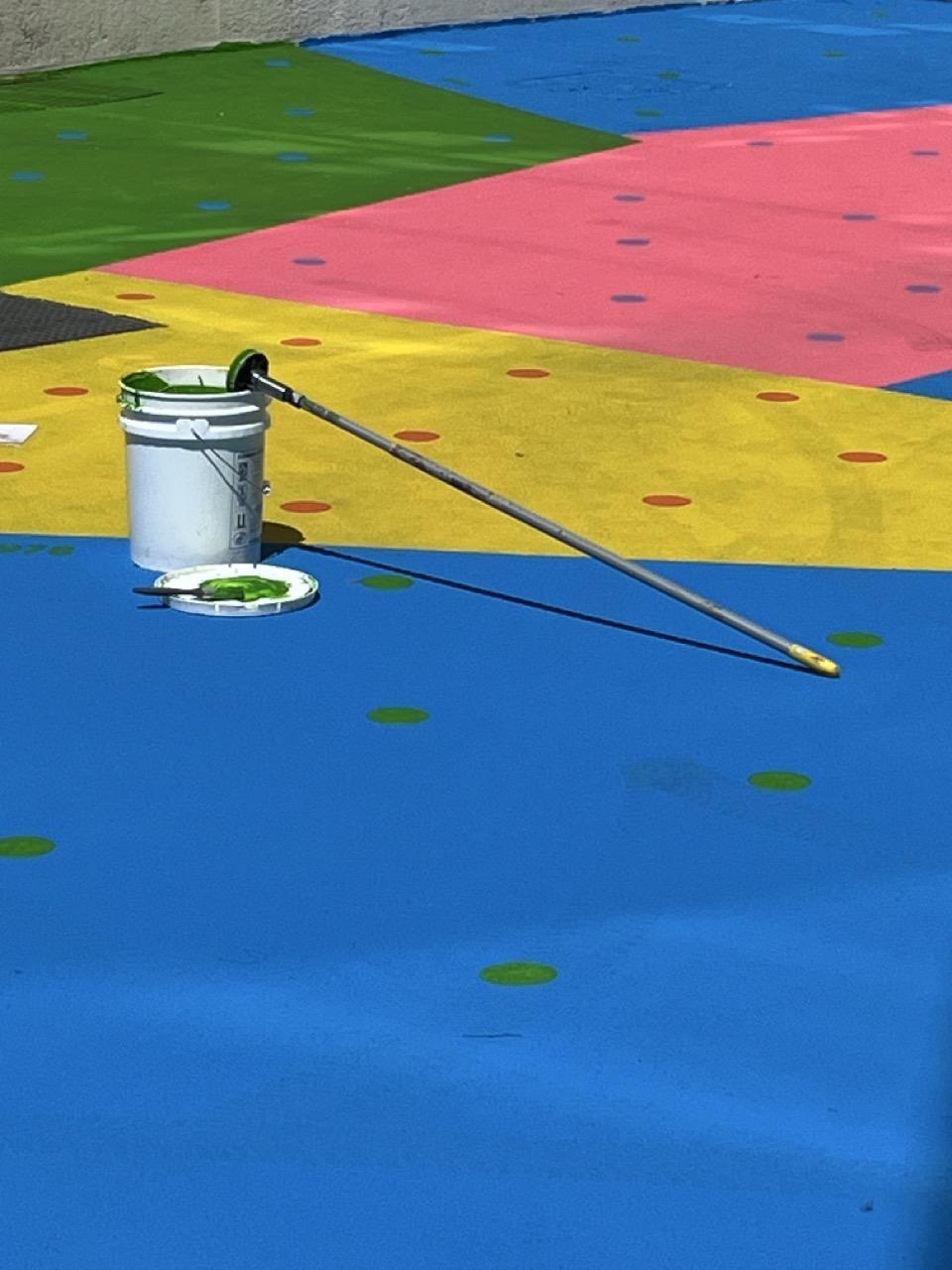
Projekt: CO₂ntext Foto: Bundestheater Holding © Bundestheater Holding
Through the CO₂ntext project, the Heidi Horten Collection, in collaboration with the Bundestheater-Holding and ART for ART, is sending a clear message about climate awareness and sustainable urban design. The focus is on the colorful floor murals in the Hanuschhof—the plaza between the Heidi Horten Collection and the surrounding buildings—which are not only aesthetically pleasing but also have a positive effect on the microclimate.
“It was a central concern of ours to use the Heidi Horten Collection not only to create a space for art but also to actively assume social responsibility. With CO₂ntext, we’re transforming the Hanuschhof into a place that brings together climate, city, and art—and demonstrate that even small urban interventions can have a big impact,” say the curators of the Heidi Horten Collection.
since June 2025
The Graz-based artist collective Holla Hoop designed the courtyard using an innovative, UV-reflective special paint that reflects the sun’s rays more effectively than, for example, a dark asphalt surface. The result: a measurable cooling of the microclimate in the Hanuschhof, which benefits not only museum visitors and the staff of the offices and costume workshops located there, but also residents and passersby in the surrounding area.