


We can't find the internet
Attempting to reconnect
Something went wrong!
Hang in there while we get back on track
Title: front: Beach Scene with Four Figures, 1921; back: Women with Masks, 1909 (Erich Heckel)
Inventory number: K-332
Dimensions/medium: 83 × 96.5 cm, oil on canvas
Characteristics: signed and dated lower left on the front “Erich Heckel 1921”
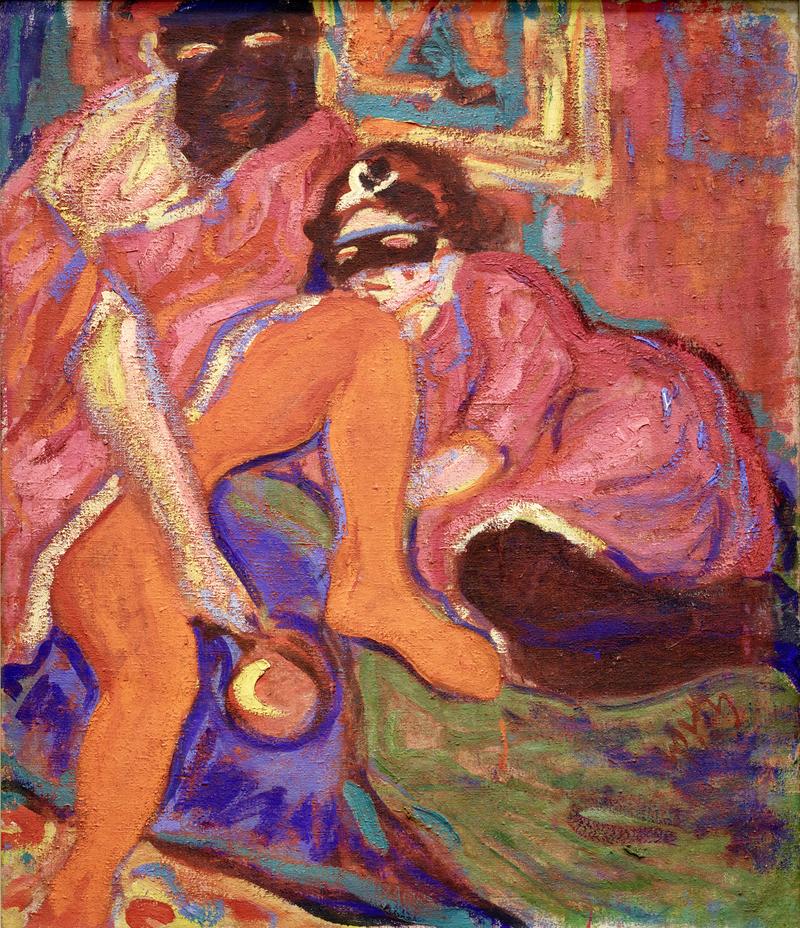
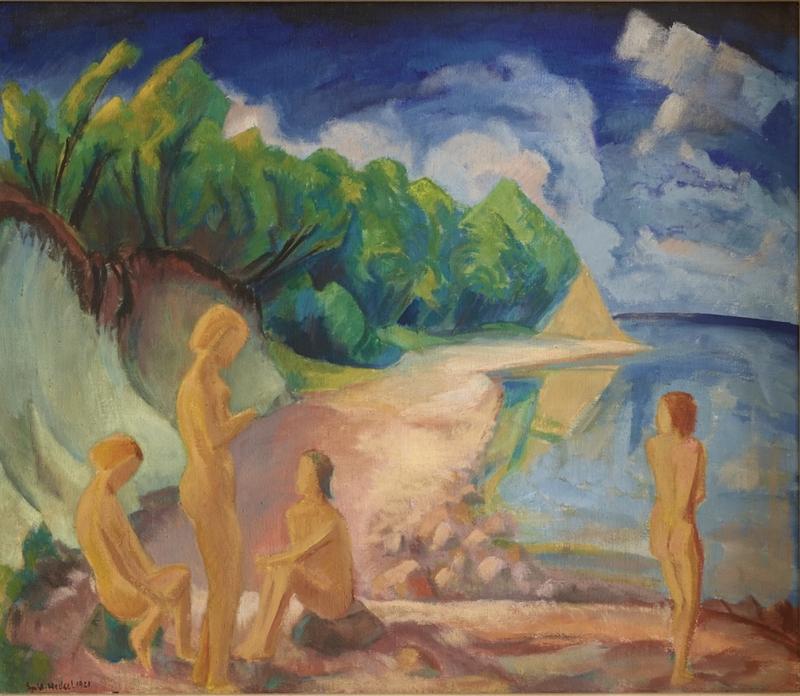
Two women, side by side, bathed in vivid red and pink, their faces hidden behind black masks. Erich Heckel composes his double portrait with energetic color and expressive brushwork. The forms are flat, the contours pulsate, and everything seems to be in motion. Perspective and anatomical precision are of secondary importance; Expressionism is concerned with expression, not representation. The mask becomes a symbol: of role-playing, of the hidden, and perhaps also of the freedom to redefine one’s identity. As in many works from Heckel’s time as a member of the artists’ group Die Brücke, the vibrant colors not only enhance the visual impact of the painting but, above all, intensify its emotional resonance. The artist painted both sides of the canvas. The beach landscape on the reverse side reflects Heckel’s style of the 1920s: clear forms, more subdued colors, and a harmonious composition have replaced the excessive drive for expression characteristic of his “Die Brücke” period. (SW)
Summary of Provenance
The beach scene with four figures/women wearing masks remained in the possession of Erich Heckel and his wife Siddi from the time of its creation in 1921 until September 1970. During World War II, the painting was kept in safe places, mostly in the basements of friends, and was retrieved after 1945, as indicated by a list compiled by Siddi Heckel. Eight months after Erich Heckel’s death, in September 1970, Siddi Heckel consigned the painting to the Wilhelm Grosshennig Gallery in Düsseldorf. From February to March 1971, *Beach Landscape with Four Figures/Women Wearing Masks* was exhibited by Grosshennig in the memorial exhibition *Erich Heckel: Works from 1905–1960*. One year later, on February 23, 1972, Siddi Heckel sold the painting to Wilhelm Grosshennig. Four years later, on October 26, 1976, Wilhelm Grosshennig sold *Beach Landscape with Four Figures/Women with Masks* to Helmut Horten.
+ PROVENANCE
| 1909/1921–1970 | Erich and Siddi Heckel / Artist’s estate |
| 1970 | Galerie Wilhelm Grosshenning, Düsseldorf (on consignment, unsold) |
| Feb. 23, 1972 | Galerie Wilhelm Grosshenning, Düsseldorf, purchased from Siddi Heckel, the artist’s widow |
| October 26, 1976 | Helmut Horten, acquired from the Wilhelm Grosshenning Gallery, Düsseldorf |
| 1987 | Heidi Horten |
| since 2022 | HGH Asset Foundation |
+ LITERATURE/ARCHIVES
|
Title: recto: Dangester Landscape, 1908 / verso: Erich Heckel and Sidi Riha, Dance in the Studio, 1911 (Erich Heckel)
Inventory number: K-347
Dimensions/Medium: 64.3 × 72.2 cm/oil on canvas
Characteristics: Monogrammed and dated on the recto “EH 08”
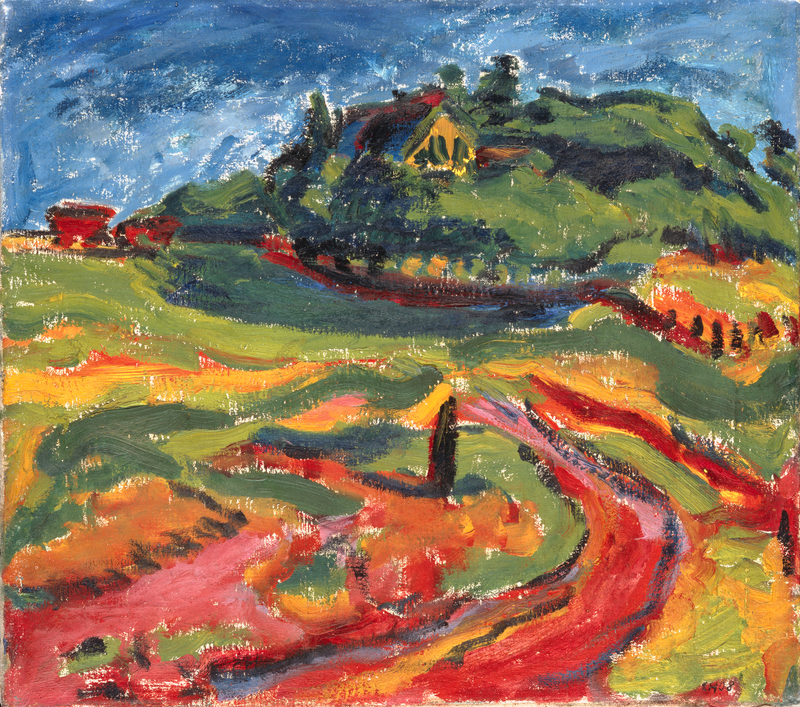
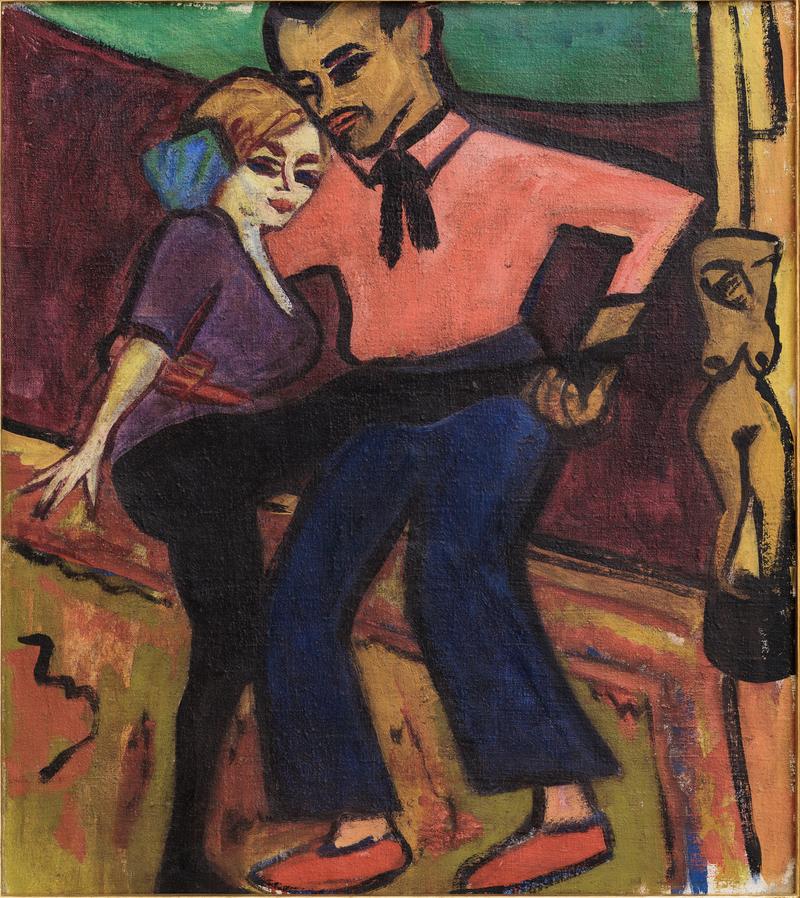
Turning one into two: Erich Heckel sometimes paints on both sides of the same canvas. On the front, the German Expressionist depicts a landscape around Dangast on the North Sea. On the back, he later adds an equally vibrant double portrait. Rotated 90 degrees to portrait orientation, the painting depicts the artist himself with the woman he loves. Her name is Milda Frida Georgi, though she is known as a dancer under the name Sidi Riha. The young couple is dancing. The setting is likely their first shared refuge, a Berlin attic that the two had decorated with rugs and fabrics they had painted themselves. Riha looks into a mirror to check her pose. As she does so, Heckel holds her outstretched leg aloft. The leg points toward an Expressionist wooden figure, standing, naked, with arms crossed above its head. For his sculptural work, Heckel was often inspired by non-European art forms, particularly their simplicity and archaic quality. (SW)
Summary of Provenance
The canvas, painted on both sides and depicting the Dangast landscape along with Erich Heckel and Sidi Riha, remained in the artist’s possession continuously until 1964 and was consigned by him to Roman Norbert Ketterer in Campione, as confirmed by the Erich Heckel estate in Hemmenhofen. In 1966, Ketterer sold the painting to the Hamburg collector Hans Ravenborg. On October 11, 2001, the painting was offered from the Ravenborg Collection at Christie’s “German and Austrian Art” auction in London and was acquired by Heidi Horten.
+ PROVENANCE
| 1908/1911 – 1964 | Erich Heckel, Hemmenhofen |
| 1964 – 1966 | Roman Norbert Ketterer, Campione |
| 1966–2001 | Hans Ravenborg, Hamburg |
| October 11, 2001 | Christie’s London, German and Austrian Art, Lot 22 |
| 2001 | Heidi Horten |
| since 2022 | HGH Asset Foundation, Vaduz |
+ LITERATURE/ARCHIVES
|