


We can't find the internet
Attempting to reconnect
Something went wrong!
Hang in there while we get back on track
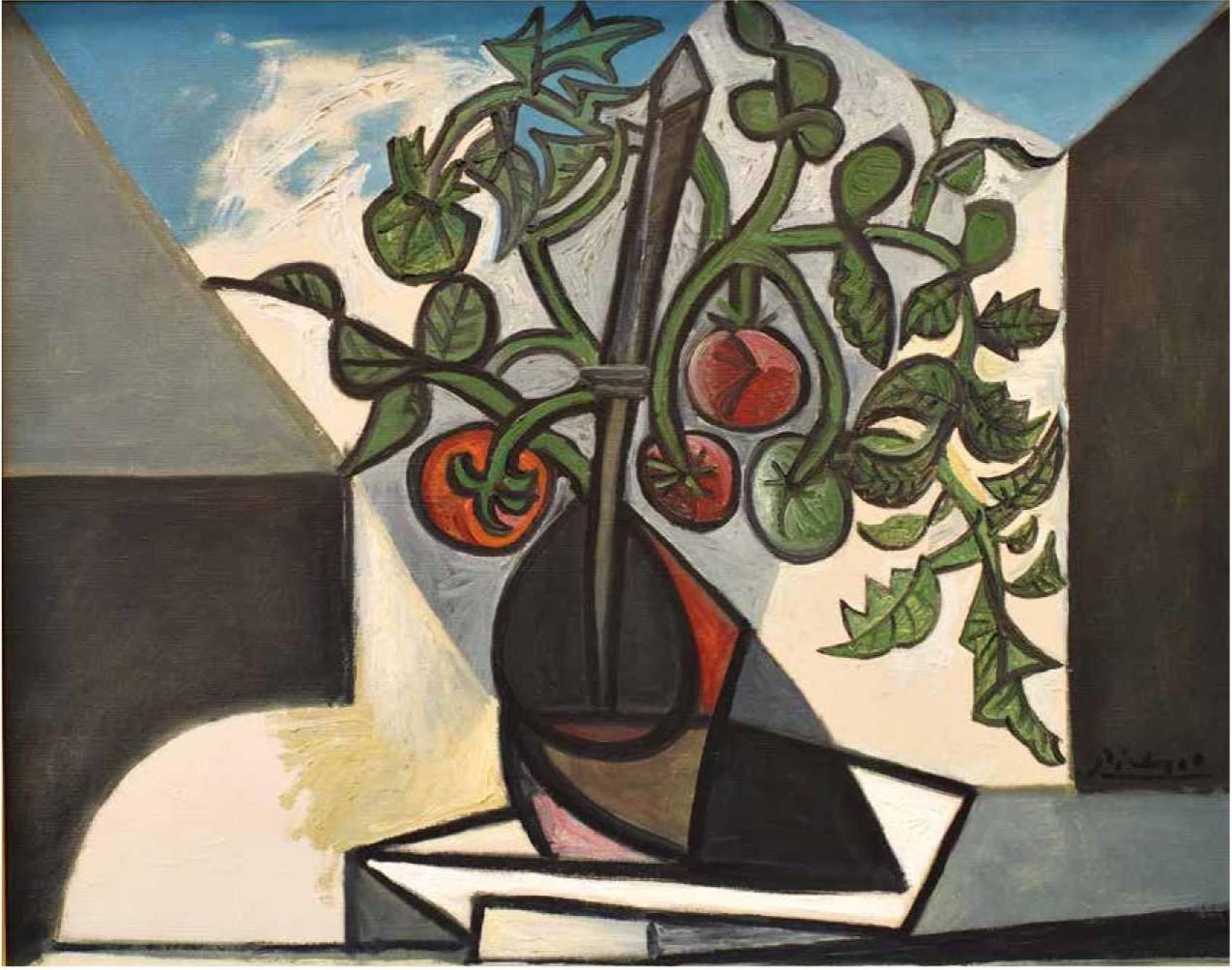
Title: Plant de Tomate, 1944 (Pablo Picasso)
Inventory number: K-1
Dimensions/Medium: 73 × 91.5 cm/oil on canvas
Characteristics: signed on the front and on the right, “Picasso”; dated on the back or on the right, “4 août 44”
Fundacio Pablo Picasso/Bildrecht, Wien, 2026
Pablo Picasso, Plant de Tomate, 1944 © Succession Picasso / Bildrecht, Wien
Picasso dated the still life August 4, 1944. Paris had been under the rule of Hitler’s troops for four years and was finally liberated three weeks later. At the time, the artist had shut himself away in his home. During his isolation, he grew tomatoes at home. In the background, Picasso hints at a dreary courtyard. In contrast, the tomato plant appears vibrant and vigorous. It serves as a distraction from Nazi terror, but also symbolizes inner resistance and a budding hope for the long-awaited liberation. “I did not paint the war,” said Picasso, “because I am not the kind of painter who seeks to depict something like a photographer. But I am certain that the war has found its way into the paintings I have created.” Picasso is considered a giant of modern art. With radical openness and extraordinary versatility, the Spanish artist drove the reinvention of art throughout his life. Nineteen works by this exceptional artist are represented in the Heidi Horten Collection. (SW)
Summary of Provenance
According to the artist’s date on the back of the painting, Pablo Picasso’s *Plant de Tomate* was created on August 4, 1944, in Paris, and, based on current research, was likely revised by him on August 12, 1944. It remained in the artist’s possession until 1946 and—as evidenced by a label on the back of the painting—may have been in the collection of A. P. Rosenberg & Co., Inc., as early as 1949. Paul Rosenberg (1881–1959), who had run one of the most important galleries in Paris before World War II, representing Picasso, Matisse, Braque, and Léger—had fled with his family to New York in 1940, where he opened his gallery, Rosenberg & Co., specializing in contemporary, American, and European art that same year. Paul Rosenberg represented Picasso on the American market, which is why the painting was likely sent directly from the artist to the Rosenberg family. On June 6, 1951, the painting was sold to Thomas May, an American department store entrepreneur and long-time head of the May Company in Los Angeles. The painting remained in May’s possession until his death on August 26, 1968. It is unclear whether, after his death, it passed to his wife or directly to his children as heirs. On November 14, 1989, the painting was sold at Christie’s in New York to an unknown buyer during the “Impressionist and Modern Paintings and Sculpture—Part I” auction. On November 9, 1999, the painting was again offered for sale at Christie’s in New York during the “Twentieth Century Art” auction, where it was purchased by Heidi Horten.
| + PROVENANCE | |
|---|---|
| August 4, 1944 – at least 1946 | Pablo Picasso’s Studio |
| […] | |
| […] – June 6, 1951 | A. P. Rosenberg & Co., Inc., New York |
| June 6, 1951 – August 26, 1968 | Thomas May Collection, Beverly Hills |
| August 26, 1968 – November 14, 1989 | May Family Collection, Beverly Hills |
| November 14, 1989 | Christie’s, New York, Impressionist and Modern Paintings and Sculpture, Part I, Lot 83 |
| November 9, 1999 | Christie’s, New York, Twentieth-Century Art, Lot 531 |
| 1999 | Heidi Horten |
| since 2022 | HGH Asset Foundation, Vaduz |
| LITERATURE/ARCHIVES |
|---|
| New York, Museum of Modern Art, The Paul Rosenberg Archives |
| Christian Zervos, Pablo Picasso, vol. 14, works from 1944 to 1946, Paris 2013, cat. nos. 28, 29, ill. pp. 18, 19 |
| Auction catalog, Christie’s, New York, Nov. 14, 1989, Lot 83 with illustration |
| Auction catalog, Christie’s, New York, November 9, 1999, Lot 531 with illustration |
| Alfred H. Barr, *Picasso: Fifty Years of His Art*, ill. p. 237 |
| Harriet Janis, *Picasso: The Recent Years 1939–1946*, New York 1946, ill. no. 30 |
| The Picasso Project (ed.), Picasso’s Paintings, Watercolors, Drawings, and Sculpture. A Comprehensive Illustrated Catalog, 1885–1973. Nazi occupation 1940–1944, San Francisco 1999, p. 372, ill. nos. 44–141 (First State), p. 375, ill. nos. 44–148 (Final State) |
| Anna Simon, exhibition review “Wow! Heidi Horten Collection,” in: Journal of Art History, Vol. 22, No. 4, 2018, pp. 386–396. Here: Fig. 3, p. 391 |