


We can't find the internet
Attempting to reconnect
Something went wrong!
Hang in there while we get back on track
Title: Red File, 1912 (Ernst Ludwig Kirchner)
Inventory number: K-455
Dimensions/medium: 120 × 90 cm, oil on canvas
Characteristics: signed and dated lower right “E. L. Kirchner 1912”
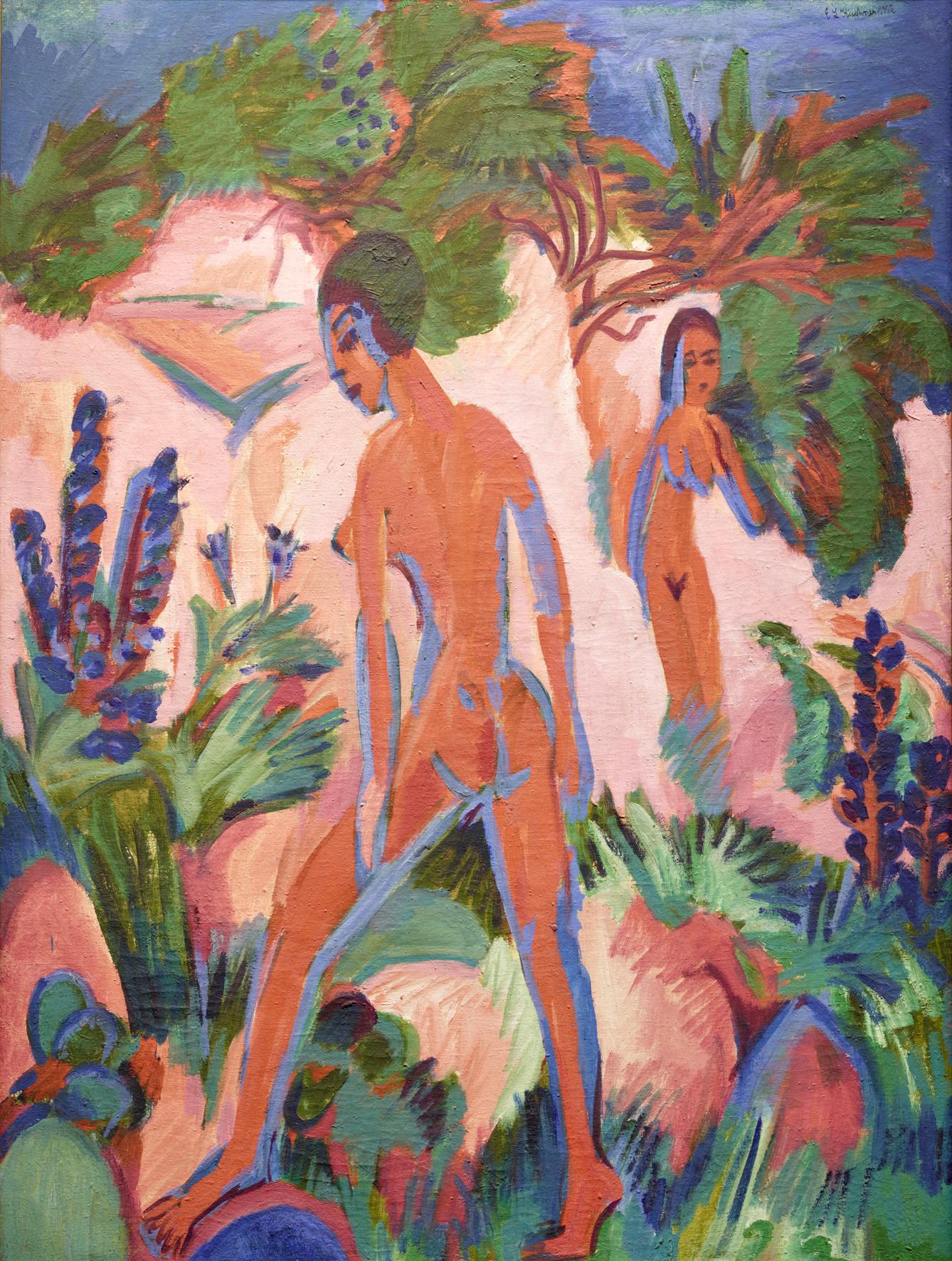
© Heidi Horten Collection / Photo: © kunst-dokumentation.com
Shortly after 1900, Ernst Ludwig Kirchner, co-founder of the artists’ group Die Brücke, discovered a fascinating world at the Dresden Museum of Ethnology. African and Oceanic sculptures and masks—with their simplified forms and expressive lines—captivated the young painter. Inspired by these objects, Kirchner developed an angular, abstract figurative style. The painting *Rote Akte* is a good example of this. Two women dressed in bright red move freely amid lush vegetation. The shades of pink could represent sandy dunes, with a deep blue sky gleaming above. Kirchner’s longing for a free, primal life finds expression in these nude figures. As a counterpoint to the modern metropolis, he sought out alternative paradises—first at the Moritzburg Ponds near Dresden, then, as in this painting, on the Baltic Sea island of Fehmarn, and finally in the Swiss Alps. (SW)
Summary of Provenance
The Red Nudes, which are part of the series of paintings created on the island of Fehmarn, were taken by Kirchner to Switzerland in 1917, where he had retreated following the traumatic experiences of World War I. In the years that followed, the artist repeatedly sought a buyer for the painting. In 1925, he asked the art historian Will Grohmann to include the “Red Nudes” in his publication on Kirchner’s work. A client of the Berlin art dealer Ferdinand Möller subsequently inquired about the “Red Nudes” in 1929. However, he ultimately declined to purchase them, as did Kirchner’s collector and patron Carl Hagemann, and the chief physician of the Park Sanatorium in Davos, Dr. Frédéric Bauer. Thus, the *Red Nudes* remained unsold until Kirchner’s death on June 15, 1938, and subsequently became part of his estate. In October 1950, the painting was sold from the estate exhibition at the Kunstmuseum St. Gallen to the Zurich collector Dr. E. Amstad. On October 9, 2002, Heidi Horten acquired *The Red Nude* at the Sotheby’s “German & Austrian Art” auction in London.
+ PROVENANCE
| Until 1938 | Ernst Ludwig Kirchner |
| 1938–1950 | Estate of E. L. Kirchner, Davos, Switzerland |
| 1950 | Dr. E. Amstad, Zurich; acquired from the Ernst Ludwig Kirchner Estate Exhibition, Kunstmuseum St. Gallen |
| Oct. 9, 2002 | Sotheby’s, London, German & Austrian Art, Lot 15 |
2002–2022 | Heidi Horten |
Since 2022 | HGH Endowment Foundation, Vaduz |
+ LITERATURE/ARCHIVES
| Ernst Ludwig Kirchner Archive, Wichtrach |
| Ferdinand Möller Archive, Berlinische Galerie, Berlin |
| Will Grohmann Archive, Staatsgalerie, Stuttgart |
| Delfs, Hans/Mario-Andreas von Lüttichau/Roland Scotti (eds.), Kirchner, Schmidt-Rottluff, Nolde, Nay ... Letters to the Collector and Patron Carl Hagemann, Ostfildern-Ruit 2004, Letter No. 207, p. 145 |
| Delfs, Hans/Roland Scotti, “Letters from Ernst Ludwig Kirchner and Erna Schilling to Dr. Frédéric Bauer,” in: Magazin V, Kirchner Museum Davos, 2004, pp. 53–168 |
| Delfs, Hans (ed.), Ernst Ludwig Kirchner: The Complete Correspondence, Vol. 2: Letters from 1924 to 1929, Vol. 3: Letters from 1930 to 1942, Zurich 2010, Nos. 1512, 1516, 1522, 1529, 1556, 1598, 2093, 2095, 2246, 2251, 2253, 2274, 2291, 2318, 2319, 2325, 2598, 2614 |
| Gercken, Günther, *The Work of Ernst Ludwig Kirchner* by W. Grohmann, Munich 2016, pp. 37, 81, cat. no. 2 |
| Gordon, Donald E., “Kirchner in Dresden,” in: The Art Bulletin, September–December 1966, XLVIII, No. 3–4, pp. 335–366, p. 360 |
| Gordon, Donald E., Ernst Ludwig Kirchner: With a Critical Catalog of All Paintings, Munich 1968, No. 347 (p. 324) |
| Grisebach, Lothar, Ernst Ludwig Kirchner’s Davos Diary: A Portrait of the Painter and a Collection of His Writings, Cologne 1968 |
| Grohmann, Will, The Work of Ernst Ludwig Kirchner, Munich: Kurt Wolff, 1926, no. 2, color ill. 2. |
| Grohmann, Will, E. L. Kirchner, Stuttgart: W. Kohlhammer, 1958, p. 62, plate p. 31 |
| Kessler, Charles, “Sun Worship and Anxiety, Nature, Nakedness, and Nihilism in German Expressionist Painting,” in: *Magazine of Art*, 1952, vol. XLV/7, ill. p. 23 |
| López Blásquez, Manuel, *Kirchner, 1880–193* (Series: *Grandes Pintores del Siglo XX*, No. 37), Madrid: Globus, [1995], color plate 10 |
| Lüttichau, Mario-Andreas von, “Two Nude Figures in a Landscape: A New Attribution,” in: North Carolina Museum of Art Bulletin, XVII, 1997, pp. 20–39, p. 27, b/w ill. 7 |
| Myers, Bernard, “Ernst Ludwig Kirchner and Die Brücke,” in: *Magazine of Art*, 1952, vol. XLV/1, pp. 20–26; ill. p. 23 |
| Myers, Bernard, *The German Expressionists: A Generation in Revolt*, New York: Praeger, 1957, pp. 128–130, fig. 131, p. 346 |
| Reinhardt, Dietrich, “A New Memorial to Kirchner on Fehmarn,” in: Davoser Revue, vol. 67, No. 3, 1992 (special issue marking the opening of the Ernst Ludwig Kirchner Museum on September 4, 1992), pp. 49–53, p. 53 |
| Schick, Karin, “Color in Black and White: Compositions by Kirchner,” in: “No One Has These Colors Like I Do.” Kirchner Paints, exhibition catalog, Kirchner Museum Davos, December 4, 2011 – April 15, 2012), pp. 61–79, p. 65, p. 66 |
| Schick, Karin, “Happiness in a Corner: Kirchner on Fehmarn,” in: “Big-City Frenzy, Natural Idyll: Kirchner—The Berlin Years,” exhibition catalog, Kunsthaus Zürich, February 10–May 7, 2017), pp. 32–43, p. 42 |
| Schick, Karin, “Every Person’s Work Is an Organic Whole.” Ernst Ludwig Kirchner in Switzerland, in: Ernst Ludwig Kirchner. The Swiss Years. From the E. W. Kornfeld Collection, exhibition catalog, Brücke Museum Berlin, December 15, 2018–March 31, 2019 |
| Schmidt, Georg, 20th-Century Painting in Germany: Painting in Germany 1900–1918; Painting in Germany 1918–1955, Königstein im Taunus: Köster, 1966, p. 16, color ill. p. 18 |
| Scotti, Roland, “Ernst Ludwig Kirchner,” in: The Great Expressionists: Masterpieces and Artists’ Lives, edited by Magdalena M. Moeller, Cologne 2000, pp. 88–109, p. 96, color plate, p. 101 |
| Stadler, Wolfgang, What Modern Painting Tells Us: From Impressionism to Tachism, Freiburg im Breisgau, Basel, Vienna 1964, pp. 97–98, color ill. 67, p. 96 |