


We can't find the internet
Attempting to reconnect
Something went wrong!
Hang in there while we get back on track
Title: Church in Unterach am Attersee (Gustav Klimt, 1915/16)
Inventory number: K-855
Dimensions/medium: 110 x 110 cm, oil on canvas
Characteristics: Signed lower right “GUSTAV -/ KLIMT”
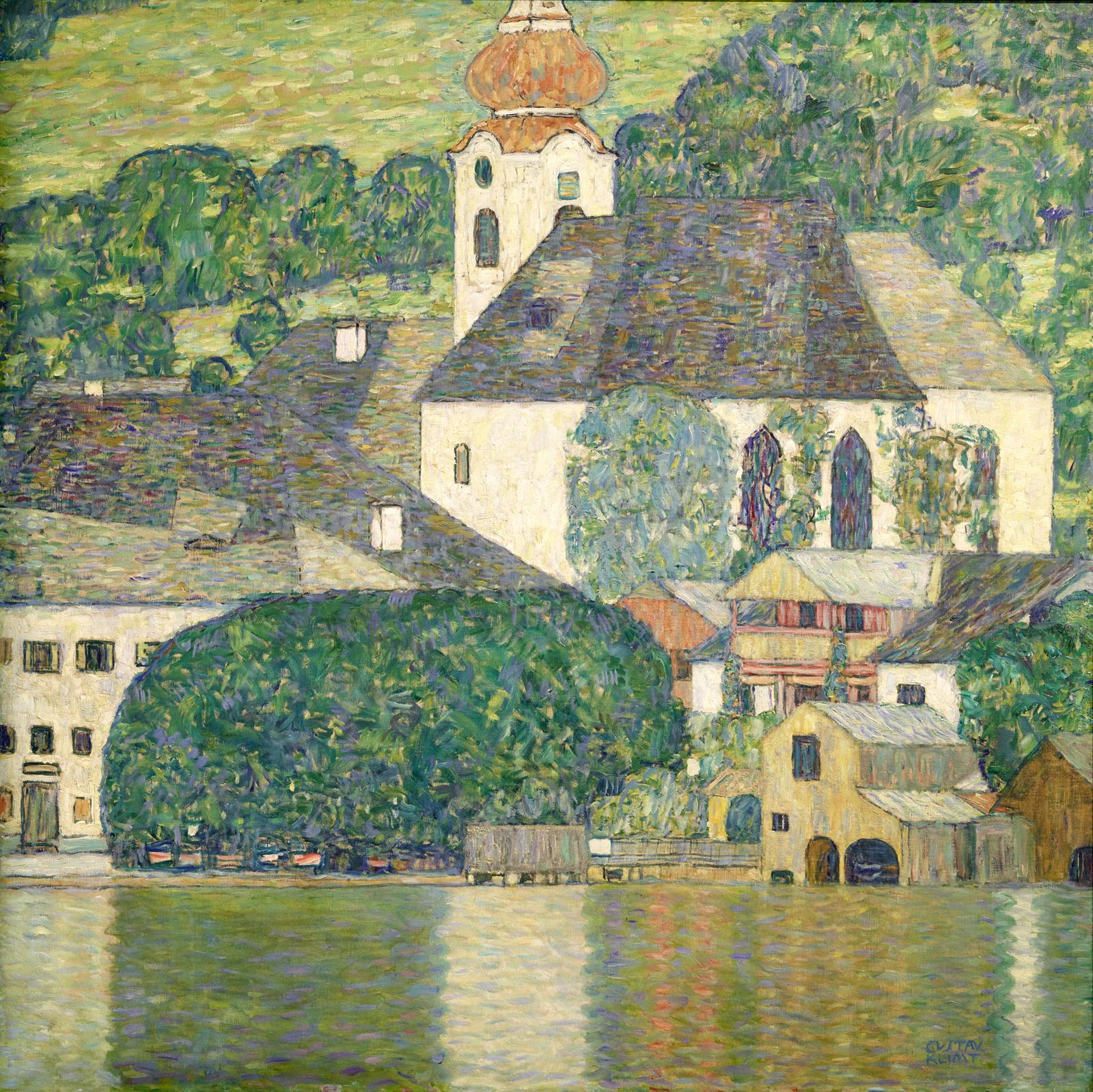
Gustav Klimt, Kirche in Unterach am Attersee, 1916 © Heidi Horten Collection
“Arrived safely; forgot my opera glasses—I really need them,” Klimt writes to his sister Hermine from his vacation home on Lake Attersee in Upper Austria. The artist is on a summer retreat and is painting without a commission, purely out of personal interest. He often achieves his unconventional perspective using optical aids such as the requested opera glass or a telescope. Klimt likely isn’t capturing the small town of Unterach from a boat either. The painter is standing about three kilometers away on the opposite side of the lake. When viewed through the telescope, the church and the houses appear closer, lose their sense of volume, and are compressed into a flat, two-dimensional space. The tranquility of the painting stems from its square format and harmonious composition. The luminous dots and short strokes, which Klimt weaves together into a shimmering tapestry of color, are reminiscent of French Impressionism and Pointillism. (SW)
Summary of Provenance
Gustav Klimt completed the painting Church in Unterach on Lake Attersee in 1916. The first owner was the industrial magnate Fritz/Friedrich Redlich (1868–1921), who bequeathed the painting to his daughter Lisbeth/Elisabeth Redlich in his will. Elisabeth Redlich (1901–1983) married Stephan Gotthilf in 1924; in 1931, a portfolio published by the Austrian State Printing Office “Gustav Klimt. A Retrospective”—apparently as a “representative of his wife.” Following the Nazi annexation, Elisabeth Gotthilf, as a Jew, was forced to leave Austria under Nazi racial laws and emigrated with her family to England in 1938–39. There, in 1948, she took the name Glanville. She presumably was able to take the work with her to England, as she offered the painting for sale to the Austrian Gallery Belvedere in February 1954, though the gallery declined. No sale or confiscation due to Nazi persecution during the intervening period (between 1938 and 1945) could be established. About two years after offering the work for sale to the Belvedere, Elisabeth Glanville found a prospective buyer in Fritz Böck, a Graz-based merchant and art collector. From June 1957 onward, he was repeatedly documented in exhibition records as the lender of the work. After Fritz Böck’s death in 1966, the work passed by inheritance to his son, Peter Böck, who sold it to Heidi Horten in 2011.
+ PROVENANCE
| 1916 | First owner: Friedrich “Fritz” Redlich (1868–1921) |
| 1921–1956/57 | Elisabeth Redlich, from 1924 Elisabeth Gotthilf, from 1948 Elisabeth Glanville |
| 1937 | Exposition d’Art Autrichien at the Musée du Jeu de Paume des Tuileries, Paris |
| 1937 | Exhibition of Austrian Painting and Sculpture in the 20th Century at the Kunstmuseum Bern |
| 1954 | Offer of sale by Elisabeth Gotthilf to the Austrian Gallery Belvedere; rejected by the Austrian Gallery Belvedere |
| 1956/57–1966 | Dr. Friedrich “Fritz” Böck (1895–1966), Graz; purchase arranged by Galerie Welz, Salzburg |
| 1966–2010 | Dr. Peter Böck, Graz |
| October 28, 2010 | The Austrian Federal Monuments Office places the painting under protection. |
| 2011 | Heidi Horten |
| 2020 | HGH Asset Foundation |
+ LITERATURE/ARCHIVES
|