


We can't find the internet
Attempting to reconnect
Something went wrong!
Hang in there while we get back on track
Title: recto: Doe with Fawn IV, ca. 1931 (Stanislaw Kubicki)
Inventory number: K-1789
Dimensions/medium: 100 × 80 cm/oil on wood
Characteristics: -
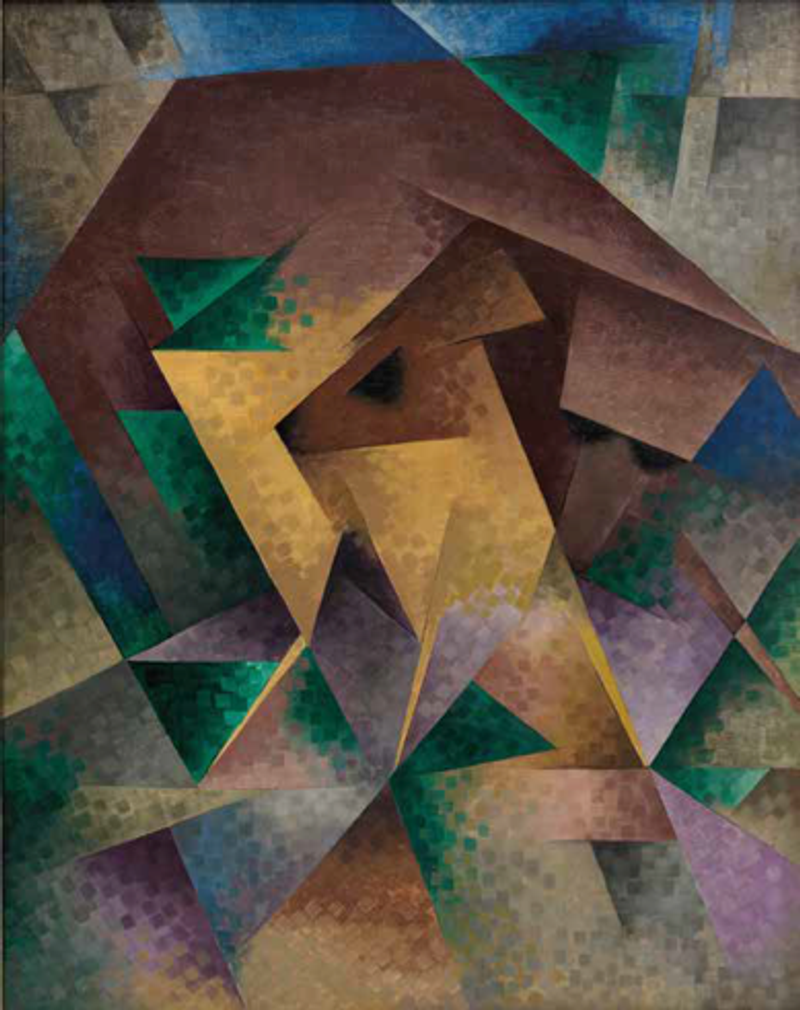
Using angular and acute-angled surfaces, Stanislaw Kubicki creates a serene scene in the forest. Drawing inspiration from Cubism, he reduces animals and the landscape to geometric forms. Small, predominantly square areas of color create light and shadow, while smooth transitions suggest the forest floor. The doe stands out clearly from the background with her large, almost solid form. A few precise lines outline her back and neck, while the fawn is composed of smaller, more fragmented elements. A triangle formed by the lines of its legs emphasizes the intimate bond between mother and fawn. Kubicki is one of the leading figures of Cubism. Unlike the French Cubists, he is not interested solely in geometric form; rather, his strict grids express a new, almost mystical sense of nature. As an artist, he builds an important bridge between Germany and Poland and has a decisive influence on Modernism in Central Europe. (SW)
Summary of Provenance
Heidi Horten acquired the painting *Hirschkuh mit Jungen IV* by the Polish artist Stanislaw Kubicki (1889–1942) on June 7, 2022, from Lehr Kunstauktionen GmbH, Berlin. The painting remained in the estate of artist Stanislaw Kubicki—who was murdered in June 1942 while in Gestapo custody in Warsaw—from 1931 through its sale in 2022.
+ PROVENANCE
| 1931 to July 2022 | Estate of the artist Stanislaw Kubicki (1889–1942), Berlin |
| July 7, 2022 | Heidi Horten, Vienna, acquired from Lehr Kunstauktionen, Berlin |
| 2022 | HGH Vermögensstiftung |
+ LITERATURE/ARCHIVES
Lidia Głuchowska, Stanisław Kubicki. Art and Theory, WIR-Verlag, Berlin 2003; Lidia Głuchowska, “Margarete and Stanislaw Kubicki—a German-Polish Artist Couple Between Poznań and Berlin,” in: Małgorzata Omilanowska and Anna Straszewska (eds.), Wanderungen: Artist – Artwork – Motif – Patron, Papers from the 10th Conference of the Working Group of German and Polish Art Historians in Warsaw, September 25–28, 2003, Warsaw 2005, pp. 129–147; Lidia Głuchowska, Avant-Garde and Love: Margarete and Stanisław Kubicki, 1910–1945, Gebr. Mann Verlag, Berlin 2007. Stanislaw Kubicki—Special Exhibition of the “Jury-Free” Artists, 6th Series, Working Group of the “Jury-Free” Artists, Berlin, July 1931.