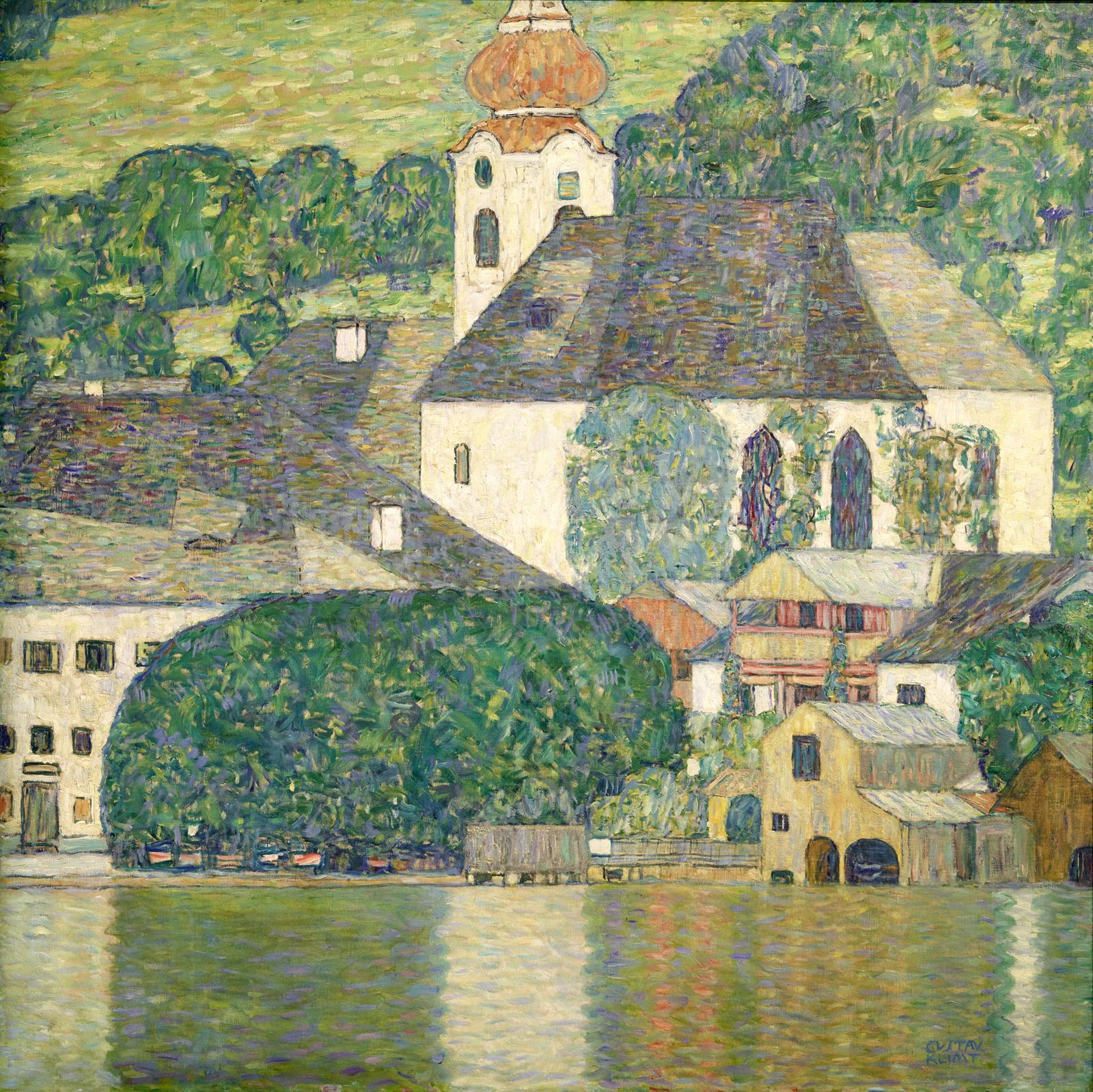

The Church in Unterach am Attersee is one of Gustav Klimt’s most significant paintings. Created in 1915–16, it is also one of his last landscapes. Since 1900, Klimt had regularly spent his summers at Lake Attersee, usually accompanied by his “life partner” Emilie Flöge, and for the last two years at the Weißenbach Forest House. On the opposite side of the lake lies Unterach. Equipped with a piece of cardboard with a square hole cut out of it, Klimt sets out in search of a subject. Once the subject—or rather, the right composition—is found, Klimt begins to paint. Everything in the church in Unterach am Attersee is bathed in glistening light; Klimt largely dispenses with the depiction of shadows, and entirely with those of the sky, causing the landscape to appear strangely flat, without spatial depth. It is—entirely in the spirit of Art Nouveau and the art of Vienna around 1900—ornamentalized.
+ PROVENANCE
1916
First owner: Friedrich “Fritz” Redlich (1868–1921)
1921–1956/57
Elisabeth Redlich, from 1924 Elisabeth Gotthilf, from 1948 Elisabeth Glanville
1937
Exposition d’Art Autrichien at the Musée du Jeu de Paume des Tuileries, Paris
1937
Exhibition of Austrian Painting and Sculpture in the 20th Century at the Kunstmuseum Bern
1954
Offer of sale by Elisabeth Gotthilf to the Austrian Gallery Belvedere; rejected by the Austrian Gallery Belvedere
1956/57–1966
Dr. Friedrich “Fritz” Böck (1895–1966), Graz; purchase arranged by Galerie Welz, Salzburg
1966–2010
Dr. Peter Böck, Graz
October 28, 2010
The Austrian Federal Monuments Office places the painting under protection.
2011
Heidi Horten
2020
HGH Asset Foundation
+ LITERATURE
Typewritten copy of the “Addendum and Amendment to My Will of March 2, 1920,” written and signed by Fritz Redlich on August 20, 1921, Göding, August 20, 1921, Austrian National Library, Vienna, Manuscript Collection
Austrian Art. Monthly Journal for the Visual Arts and Their Relationship to Cultural Life, Vol. 1931, Nos. 4, 7, 8, and 9, n.p.; Art for All. Painting, Sculpture, Graphic Art, Architecture, Vol. 47, 1931/32, p. 152; Oesterreichische Buchhändler-Correspondenz, December 12, 1931, p. 274
Exposition d’Art Autrichien, exhibition catalog, Musée du Jeu de Paume des Tuileries, Paris, Paris 1937, p. 34
Exh. cat.
Austrian Painting and Sculpture in the 20th Century, exhibition catalog, Kunsthalle Bern, Bern 1937, p. 14, cat. no. 7
Exh. cat.
List of Exhibition Objects to Be Insured for Bern, Kunsthaus Bern, Archive, Loan Exchange Exhibition 1937
Gustav Klimt. A Retrospective, Vienna 1946, p. 19
Wilhelm Jenny, Franz Pfeffer (eds.), Art in Austria 1851–1951. Contributions to Austrian Art History of the 19th and 20th Centuries, Linz 1951, p. 114 and caption for fig. 15
Letter from Elisabeth Gotthilf (then Elisabeth Glanville) to the Austrian Gallery Belvedere dated February 24, 1954, Belvedere Archive, File No. 124/1954
Ingomar Hatle, Gustav Klimt. A Viennese Art Nouveau Painter, unpublished dissertation, University of Graz, 1955, Appendix Works No. 126
Emil Pirchan, Gustav Klimt, Vienna 1956, p. 55
Austrian Landscape Painting from Schindler to Klimt, exhibition catalog, Neue Galerie at the Landesmuseum Joanneum in the Künstlerhaus Graz, Graz 1957, cat. no. 31
Exh. cat.
The Classics of Austrian Modern Art from Klimt to Wotruba, exhibition catalog, Württembergischer Kunstverein, Stuttgart, Stuttgart 1957, cat. no. 34 (Unterach am Attersee)
Exh. cat.
XXIX. Esposizione Internazionale d’Arte La Biennale di Venezia – Austrian Pavilion, exhibition catalog, Venice 1958, p. 204, cat. no. 12
Exh. cat.
Letter from Elisabeth Glanville (Gotthilf) to President Otto Demus, Austrian Federal Monuments Office, dated October 9, 1958, Austrian Federal Monuments Office Vienna, Archive, Ref. 148/Res/58
Johannes Dobai, The Early Work of Gustav Klimt, unpublished dissertation, University of Vienna, 1958, Vol. 2, p. 154
Gustav Klimt. Memorial Exhibition on the Occasion of the 100th Anniversary of Gustav Klimt’s Birth. With works from private and public collections in [sic] Styria, exhibition catalog, Neue Galerie at the Landesmuseum Joanneum, Graz, Graz 1962, cat. no. 5
Exh. cat.
Gustav Klimt. Paintings and Drawings, exhibition catalog, Marlborough Fine Art Ltd., London, London 1965, cat. no. 6
Exh. cat.
Gustav Klimt and Egon Schiele, exhibition catalog, The Solomon R. Guggenheim Museum, New York, New York 1965, p. 46, cat. no. 18
Exh. cat.
Fritz Novotny, Johannes Dobai, Gustav Klimt, Salzburg 1967, p. 364
Cat. rais.
Fritz Novotny and Johannes Dobai, Gustav Klimt, 2nd ed., Salzburg 1975, p. 364
Cat. rais.
Letter from Joseph Redlich to Hermann Bahr, February 11, 1918, published in: Fritz Fellner (ed.), Poet and Scholar. Hermann Bahr and Josef Redlich in Their Letters 1896–1934, Salzburg 1980, p. 307
Image and Emotion. Austrian Realism 1914–1944, exhibition catalog, Austrian Museum of Applied Arts, Vienna, Künstlerhaus Palais Thurn und Taxis, Bregenz, Vienna 1984, p. 10, no. 2
Exhibition catalog
Gustav Klimt and the Vienna Secession 1897–1997, exhibition catalog, Vienna Secession at the Fiera di Roma, Manduria 1997, p. 64, ill. 54
Exh. cat.
Gert Kerschbaumer, Master of Confusion. The Business of Art Dealer Friedrich Welz, Vienna 2000
Ilse von zur Mühlen, “Leopold von Kalckreuth’s Triptych ‘The Three Ages of Life’. The Case of Elisabeth Gotthilf,” in: Contributions by Public Institutions of the Federal Republic of Germany on the Handling of Cultural Property Formerly Owned by Jews (Publications of the Coordination Office for Lost Cultural Property, 1), Magdeburg 2001, pp. 246–265
Stephan Koja (ed.), Gustav Klimt, Landscapes, exhibition catalog, Austrian Gallery Belvedere, Vienna, Munich/Berlin/London, et al., 2003, ill. p. 136, see also p. 217
Exh. cat.
Bernadette Reinhold, “The Exposition d’Art Autrichien at the Jeu de Paume in Paris in 1937. A Case Study in Austro-French Cultural Policy of the Interwar Period,” in: Agnes Husslein-Arco (ed.), Vienna – Paris. Van Gogh, Cézanne, and Austrian Modernism 1880–1960, exhibition catalog, Austrian Gallery Belvedere, Vienna, Vienna 2007, pp. 307–317
Exh. cat.
Alfred Weidinger, Michaela Seiser, Eva Winkler, “Annotated Complete Catalogue of the Paintings,” in: Alfred Weidinger (ed.), Gustav Klimt, Munich/Berlin/London et al. 2007, pp. 232–311, here p. 300
Catalog
Georg Gaugusch, Once Upon a Time. The Jewish Upper Middle Class of Vienna 1800–1938, Vol. 1: A–K, Vienna 2011, pp. 990–991
Tobias G. Natter, “Documentation of All Klimt Paintings,” in: ibid. (ed.), Gustav Klimt. Complete Paintings, Cologne 2012, p. 364
Cat. rais.
Elizabeth Clegg, “War and Peace at the Stockholm ‘Austrian Art Exhibition’ of 1917,” in: The Burlington Magazine, October 2012, pp. 676–688, with a photograph of the exhibition hall on p. 680
Hansjörg Krug, “Gustav Klimt selbstredend,” in: Natter 2012, no. 177–179, pp. 461–504, here pp. 503–504
Georg Gaugusch, Wer einmal war. The Jewish Upper Middle Class of Vienna 1800–1938, Vol. 2: L–R, Vienna 2016, pp. 2872–2873 and 2874
Monika Mayer, “The Collector and His Painting. On the History of Egon Schiele’s *Embrace* from the Heinrich Rieger Collection 1917–1954,” in: Stella Rollig, Harald Krejci (eds.), Vik Muniz, exhibition catalog, Österreichische Galerie Belvedere, Vienna, Vienna 2018, p. 27
Agnes Husslein Arco (ed.), WOW! The Heidi Horten Collection, exhibition catalog, Leopold Museum, Vienna, Vienna 2018, pp. 252–279, ill. p. 273